
Santee, CA · Garage Door Service
Why Santee Garage Doors Draft Along the Bottom Seal
Santee homes built 1967-1992 often leak air through aging seals. Mild local conditions and old builder-grade seals cause drafts, not a failing opener.
- Repairs & new doors
- Springs & openers
- Serving 5 nearby communities
What Most People Get Wrong
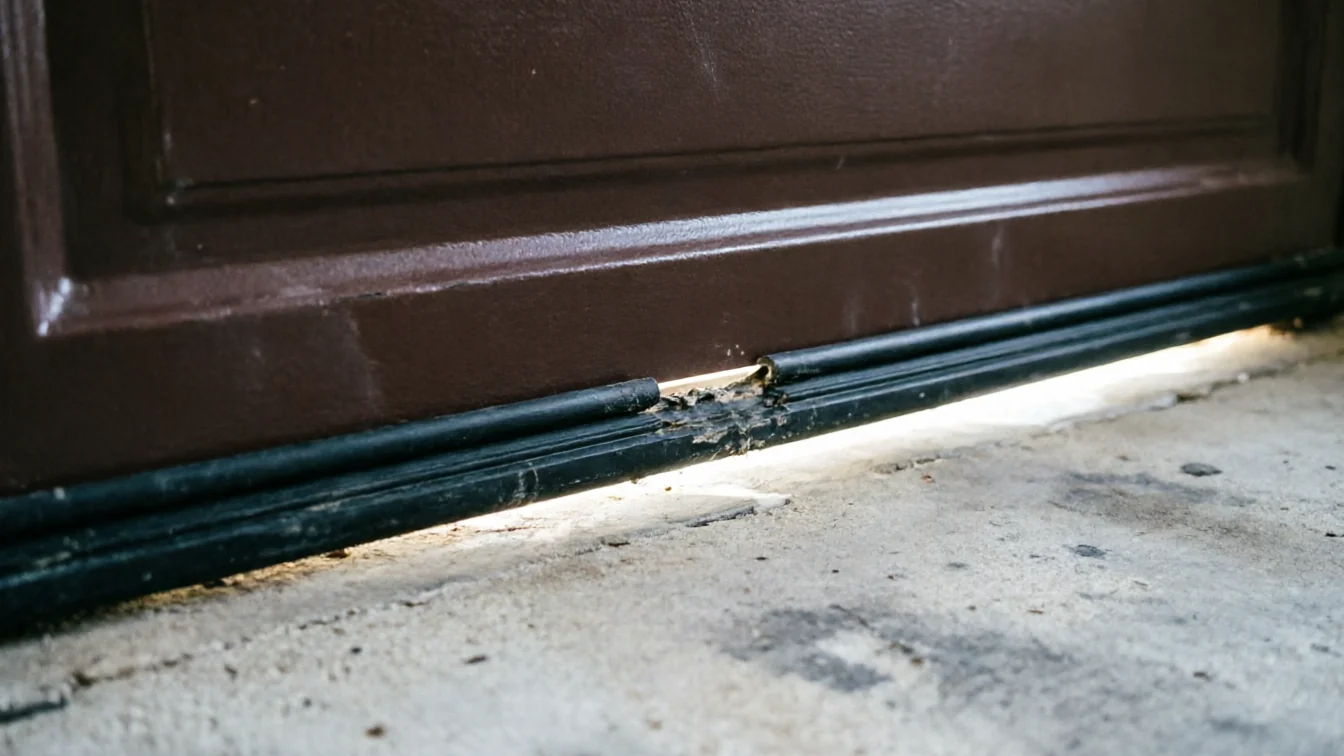
Most homeowners in Santee assume a draft under the garage door means the whole door is failing, or that the opener needs replacing. It usually doesn't. Santee's housing stock mostly went up between 1967 and 1992, with the typical house dating to around 1976, and that era of construction used a thin vinyl bottom seal set into a builder-grade aluminum retainer. That seal was never meant to last fifty years. It hardens, cracks, and pulls away from the slab long before anything in the opener or the torsion spring gives out.
The second mistake is treating the wood jamb like it's fixed in place. A jamb installed around 1976 has had decades to shrink and twist slightly as the lumber dries out, especially where it sits in direct sun most of the day. That shift opens a gap along the side seal that no amount of adjusting the bottom seal will fix, because the problem isn't the seal - it's the frame it's pressed against.
People also skip the top seal entirely, assuming drafts only come from the floor. On a lot of these older Santee doors, the top section never had a seal installed at all, since it wasn't standard when the house was built.
Doing Nothing For Now
Sometimes the right call is to leave it. If the draft is a thin line of daylight along the bottom edge and the door still opens and closes without binding, a seal swap is a small job and waiting a season costs you nothing but a little extra air leakage. We won't tell you to replace a door that's otherwise sound just because the seal is worn - that's not a repair, that's an upsell, and we don't do those.
Where waiting isn't smart: if the aluminum retainer that holds the bottom seal has started to curl or rust, or if the wood jamb has split rather than just shrunk, patching the seal buys you a few months at most before the same gap opens back up. On a lot of the 1960s-70s stock across this part of the county, that retainer is original, and once it's bent it won't hold a new seal flat no matter how many times you reseat it.
Our honest limitation here: we don't do cosmetic trim or stucco work around the jamb. If the gap is being caused by settling or water damage to the frame itself rather than the seal, that's a carpentry job first, and the seal is the last step, not the first.
How Local Conditions Play In
Santee sits in a mild temperate band, so the wear on your seals isn't the freeze-thaw cracking you'd get somewhere with hard winters. What ages a seal here is steady sun exposure and dust blowing in off the foothill grade to the east - the kind of terrain you see heading toward Eucalyptus Hills three miles out or Granite Hills six miles out. That grit works into the seal groove and acts like sandpaper every time the door cycles, wearing a shallow channel into the vinyl long before it looks obviously cracked.
Because the climate doesn't swing to extremes, a lot of homeowners never think about seals until the gap is wide enough to see daylight. There's no hard freeze forcing the issue the way there would be elsewhere. The seal just degrades slowly, year after year, until one day the garage smells like outside air.
The same pattern shows up in Bostonia and Winter Gardens, both a few miles from Santee and built on the same 1960s-70s timeline. It's not a Santee-specific defect - it's what happens to builder-grade seals left in this kind of sun and dust for forty-plus years without being swapped.
What Is Going On
Here's the mechanism, plainly. A house built around the median year for this area, 1976, has an aluminum door frame and a wood jamb that expand and contract at different rates as the day heats up and cools down. Over four decades that mismatch works the fasteners loose and opens a gap at the corner seams, right where the side seal meets the bottom seal. Once that corner gap opens, wind-driven dust gets behind the seal and pushes it further out of its track, and the problem compounds.
Across the service area, with 51,408 owner-occupied houses built mostly in this same 1967-1992 window, this is the single most common call we get about drafts. It is almost never the opener. It's the seal, the retainer that holds it, or the jamb behind it, in roughly that order of likelihood.
The fix depends on which of those three has actually failed, and you can often tell by sight: a seal that's flat and brittle versus a retainer that's visibly bent versus a jamb with a vertical crack. Guessing wrong means paying for the wrong part twice.
Frequently asked questions
Is the draft under my garage door just the weather seal, or something bigger?
Check if the gap is even along the whole bottom edge or worse at one corner. Even means the seal itself is worn and a straightforward swap. Worse at one corner usually means the jamb has shifted, which is common in houses from Santee's 1967-1992 building era and needs the frame addressed, not just the seal.
Why does my door leak air even though San Diego County doesn't get hard winters?
Santee's mild temperate climate doesn't crack seals through freeze-thaw the way cold regions do. Instead, decades of sun exposure and dust blowing off the foothill terrain east of town wear the seal down gradually, so the damage sneaks up on you instead of showing up after one bad winter.
My house was built in the 1970s. Does that matter for the seal?
Yes. A lot of Santee houses date to around 1976, and the bottom seal and retainer installed at that time were builder-grade, not made to last fifty years. If yours hasn't been replaced since the house was built, it's well past its working life regardless of how it looks from a few feet away.
Can I just caulk the gap instead of replacing the seal?
Caulk will stop a draft for a while but it cracks under the same sun and dust that wore out the original seal, and it makes the next real repair harder because you have to scrape it off first. It's a stopgap, not a fix, and we'd rather tell you that upfront.
Related garage door services in Santee
More garage door guides
Book garage door service in Santee
Call now or request a quote - tell us what the door is doing and where you are.