
Santee, CA · Garage Door Service
Is Your Santee Garage Door Worth Fixing, or Time to Replace It
Santee homes built mostly 1967-1992 still run original hardware. Here's how to tell if your door's worth repairing or replacing, based on age and local conditions.
- Repairs & new doors
- Springs & openers
- Serving 5 nearby communities
What Most People Get Wrong
The biggest mistake we see in Santee is treating every garage door problem like it's the same problem. A homeowner hears a grinding noise or sees a sagging panel and assumes the whole unit is done. Most of the time that's wrong, and sometimes it's wrong in the other direction too - someone keeps patching a door that's past the point of patching.
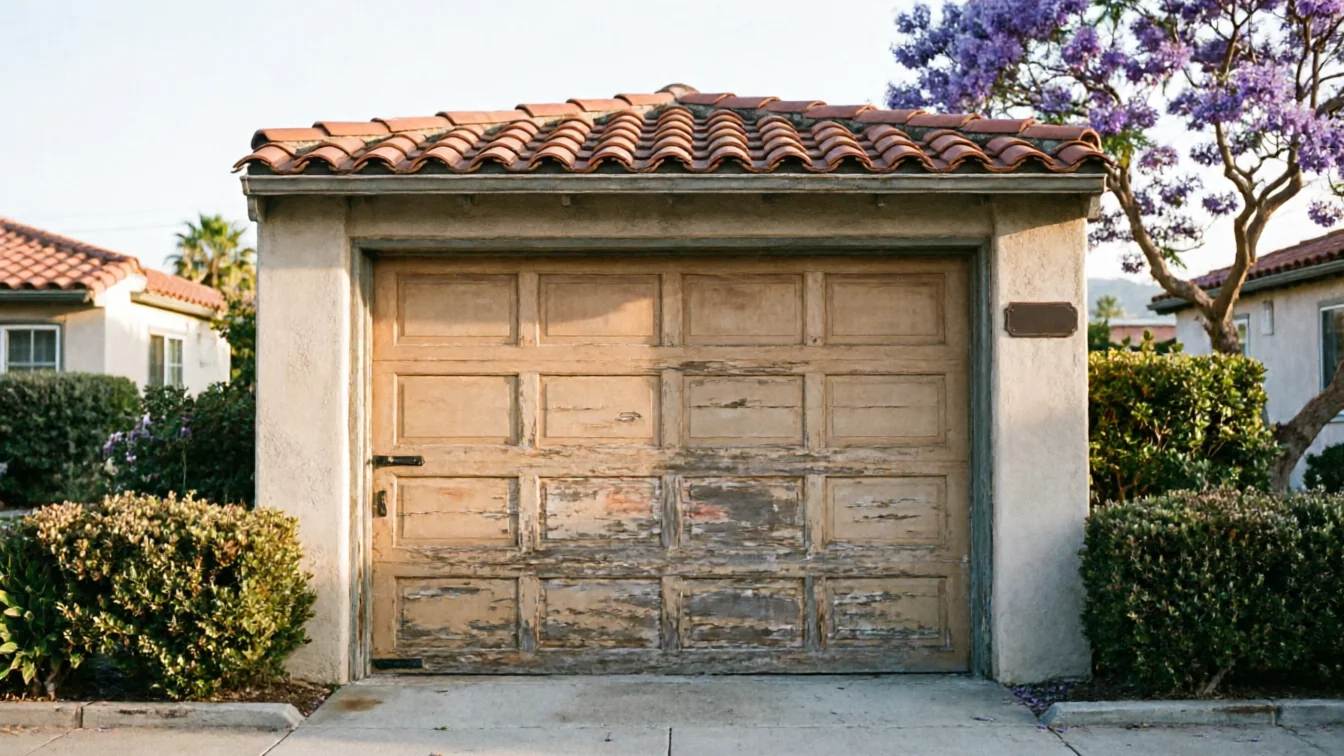
Housing in this part of the county went up mostly between 1967 and 1992, with the median build year landing around 1976. That means a huge share of the doors on the road right now are original equipment or a first-generation replacement from the 80s or 90s. Those doors were built for a different era of hardware - heavier steel, simpler openers, springs sized differently than what goes on a truck today.
The part people get wrong isn't mechanical, it's about matching the fix to the age. A 1976-era door with a broken spring is usually a fair repair. The same door with three bent panels and a worn-out track system is a different conversation, because by then you're replacing most of what makes it a 'door' anyway, piece by piece, for close to the cost of a new one.
Doing Nothing For Now
Sometimes the right call really is to do nothing. If a door from the 1970s or 80s opens and closes evenly, the springs are balanced, and the only issue is a noisy roller or a cable starting to fray, that's routine wear - not a sign the door is failing as a system. We'd rather tell a homeowner to wait and budget for a repair down the line than push a replacement on a door that still has life in it.
Where we draw the line: once a door's frame or track has been reworked more than once, or the panels show rust-through rather than surface rust, doing nothing stops being a neutral choice and starts being a bet against the next cold morning. At that point a repair bill is really a deposit on the next repair bill.
We won't tell you a door needs replacing just because it's old. Plenty of the original doors from Santee's 1960s-70s building wave are still structurally sound - the steel on those older panels is often thicker than what goes into budget doors sold today. Age by itself isn't the deciding factor. What the hardware is actually doing, right now, is.
How Local Conditions Play In
Santee sits in a mild temperate band, without the freeze-thaw cycles that crack seals and warp wood doors in colder parts of the country. That works in favor of older doors here - a steel panel from 1976 that's been kept out of direct weather damage isn't fighting the same decay a door in a harsher climate would be fighting. We see doors from that era still running on original torsion springs more often in Santee than we would somewhere with real winters.
That said, mild doesn't mean nothing happens. Across the 22 named areas that make up this mostly 1960s-70s housing stock, the common failure point isn't rust from rain, it's UV and heat cycling on vinyl weather seals and on the plastic idler wheels that later-era doors started shipping with. Garages facing full sun for a chunk of the day tend to show that first.
So the climate argument for fixing rather than replacing a Santee door is specific: the structure usually isn't the weak point, the small rubber and plastic parts are. Replace those and a lot of these older doors keep running another decade without touching the panel or frame at all.
What Is Going On
Put the pieces together and here's the actual picture for Santee: most of the housing in this service area was built between 1967 and 1992, concentrated in the 1960s-70s wave across the surrounding communities - think Eucalyptus Hills, Bostonia, Winter Gardens, Lakeside, and the other nearby areas within a few miles. That means a lot of original or near-original garage doors are still in daily use, and the mild climate here has been kind to the steel and the framing even when it hasn't been kind to the seals and rollers.
With median household income in the service area at $119,719 and roughly 51,408 owner-occupied houses among 118,148 households, most of these homes have the means to replace a door outright if they want to. But that's often not the better move financially. A sound 40-to-50-year-old door with a spring, cable, or weatherseal problem is, in most cases, a repair worth doing - not a door worth hauling to the dump.
Where we'd tell you otherwise: once the track is bent beyond adjustment, or the panels have delaminated from water that got past a failed seal years ago, repair stops making sense. That's the point where we'll say so plainly instead of running up a bill on a door that's not coming back.
Frequently asked questions
My garage door is from the 1970s. Is it even worth fixing?
Usually, yes. A 1970s-era steel door in Santee's mild climate has often held up structurally better than people expect - the steel is thicker than a lot of what's sold today. If the panels and frame are sound and the problem is a spring, cable, or roller, that's a straightforward repair, not a reason to replace the whole door.
What actually wears out first on an older Santee door?
In this climate, it's usually the small parts, not the structure: vinyl weather seals and plastic idler wheels that take years of sun and heat cycling. Springs and cables wear on a schedule too, but the rubber and plastic parts tend to go first, especially on garages that face direct sun most of the day.
When does it stop being worth repairing an old door?
Once the track has been bent and re-bent, or panels show rust-through or water damage behind a failed seal, you're usually looking at a replacement rather than another repair. At that point, patching individual parts starts costing close to what a new door would run.
Does Santee's climate make older doors last longer?
It helps. There's no freeze-thaw cycle here to crack seals or warp wood, so the structural parts of an older door age slower than they would somewhere with real winters. The tradeoff is sun exposure wearing out seals and plastic rollers faster than cold-climate doors typically see.
Related garage door services in Santee
More garage door guides
Book garage door service in Santee
Call now or request a quote - tell us what the door is doing and where you are.